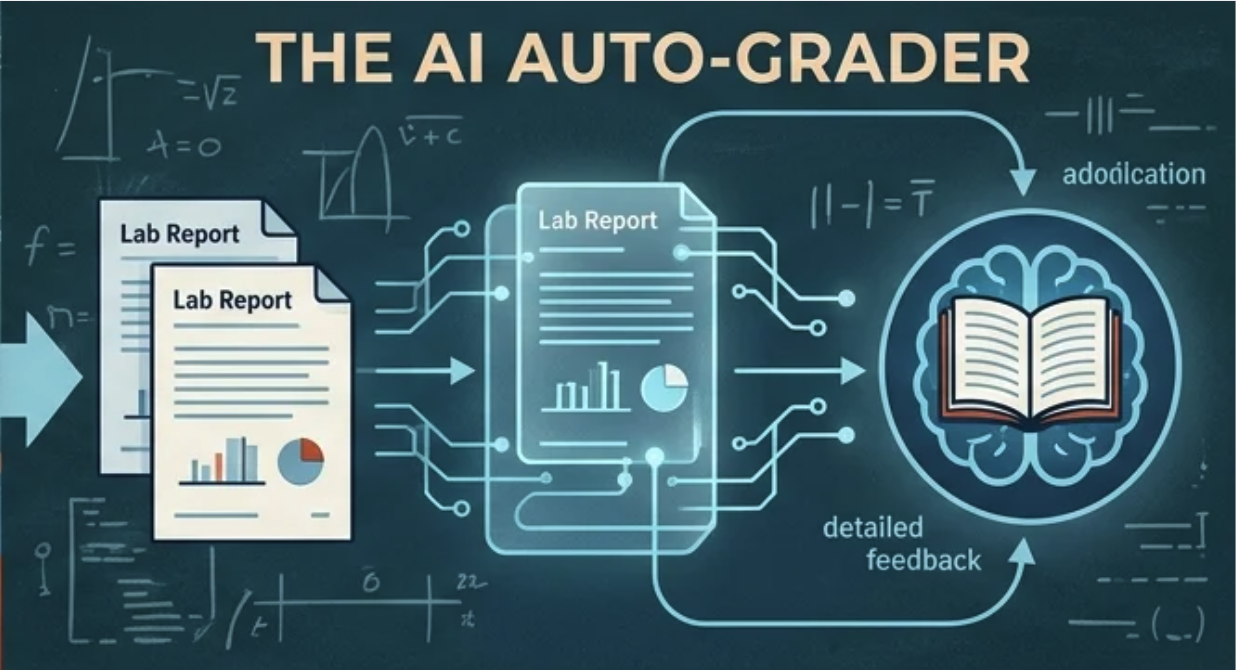
As a Graduate Teaching Assistant at Arizona State University, my baseline job description was standard: teach labs, hold office hours, and grade. But if you put a team of software and AI engineers in a room with hundreds of repetitive worksheets, quizzes, and pre-labs, they’re going to do what they do best: build an automation engine.
My team and I set out to build an end-to-end AI Auto-Grader System integrated directly with Canvas. By the time we were done, we hadn’t just saved ourselves hours of manual labor—we discovered that the AI actually graded better and more objectively than human graders ever could.
But getting there required bypassing massive data privacy hurdles, re-engineering data pipelines, and confronting a glaring question about the fundamental value of a modern university degree.
The Architecture: Canvas, OpenRouter, and Excalidraw
The core premise was straightforward: pull student submissions from the Canvas LMS API, grade them using LLMs, and push the scores back to Canvas alongside detailed feedback.
To maximize accuracy, we didn’t just throw raw prompts at an API. We built a structured grading schema engine. The system ingested the master answer key, examples of partially correct answers, and explicit rubrics on how to allocate partial credit. We primarily relied on OpenAI LLMs for inference, with a fallback routing mechanism to OpenRouter to handle rate limits and test alternative open-source models.
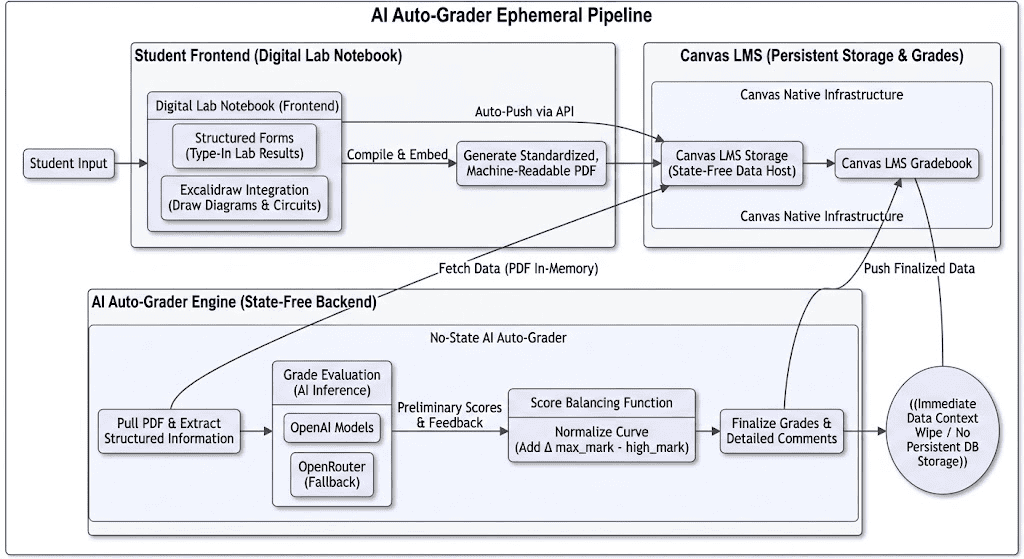
To prevent the AI from being overly punitive, we also engineered a programmatic grading balancer. The function calculated the delta between the highest achieved mark and the maximum possible mark, automatically normalizing the curve across the cohort to ensure fair evaluation.
Bypassing IT Hurdles Without Storing Data
Our biggest bottleneck wasn’t the AI—it was compliance. The ASU IT software approval team enforces strict quality and privacy standards. The primary directive: The software absolutely could not store student information.
Grading a student without holding state or keeping a database of their records forced us to build an ephemeral data pipeline. Initially, we had to resort to pulling raw PDFs from Canvas, running inference in memory, pushing the grades, and immediately wiping the data context.
To bypass the brittle nature of OCR on random student PDFs, we built a custom frontend. Students entered their answers directly into structured fields, which supported digital drawings via an integrated Excalidraw canvas. When a student hit submit, this data was cleanly embedded into a standardized PDF format and auto-pushed to Canvas, giving the LLM a pristine, structured document to evaluate in real-time.
The Discovery: Why AI Graded Better Than Us
When we compared the AI’s performance against human grading, the results surprised our professors. The AI was objectively superior in three core areas:
- Absolute Objectivity: Human graders are prone to fatigue, cognitive load, and accidental bias. An essay graded at 11:00 PM after a long day looks different than one graded at 9:00 AM. The AI evaluated the last paper with the exact same baseline logic as the first.
- Hyper-Detailed Feedback: The bottleneck for human TAs is time. We can only write so many paragraphs of explanation per student. The AI, however, provided massive, highly nuanced, and descriptive feedback on why a mark was deducted and how to fix it.
- An Actionable Feedback Loop: Because the comments were so detailed, students actually used them to improve on subsequent labs. It turned grading from a punitive metric into a genuine learning tool.
The Existential Question: If the University is AI, Why Pay for the University?
The success of this project was supported by ASU, and the faculty loved the efficiency. But as engineers building this reality, it forced us to look at the horizon.
If an AI auto-grader can evaluate technical work more accurately and provide better mentorship via feedback than a human expert constrained by time, the role of the traditional educator changes fundamentally. Teachers and graders will either become prompt architects and supervisors, or find themselves increasingly obsolete in the administrative loop.
This shifts the existential crisis down to the consumer—the student.
If the primary value of higher education has historically been access to expert evaluation, structured feedback, and curriculum delivery, what happens when that entire stack can be run locally or via a cheap API? If a student can deploy an open-source agentic pipeline to guide them through a textbook, test them, grade them objectively, and explain their mistakes for pennies, why pay tens of thousands of dollars for a university degree?
We built a tool to solve a logistics problem in a university lab. In doing so, we might have just caught a glimpse of how the traditional university model unbundles itself from the inside out.