Category: Psychology

  • Introversion isn’t real

    Introversion and Extroversion Might Not Be What You Think

    We’ve all heard of introverts, extroverts, and now, ambiverts — people who fall somewhere in between. But what if these labels don’t fully capture what’s really going on? What if your “vertedness” has less to do with your personality and more to do with what you’re talking about?

    Here’s the thing: many people who call themselves introverts seem to come alive when talking about topics they’re passionate about. I’ve had phone conversations with self-proclaimed introverts that lasted for hours — full of energy, laughter, and zero social exhaustion. Yet, these same people would be considered introverts in more general social settings. Why is that?

    It’s often said that introverts need alone time to recharge after social interaction, while extroverts gain energy from being around others. But I’m not convinced it’s that simple. Maybe introverts just need conversations that matter to them. Or maybe anyone would feel drained if the topic didn’t interest them.

    Think about it. An introvert might feel completely drained after small talk about the weather or sports they don’t follow, but light up when the topic turns to video games, anime, philosophy, or science. Suddenly, they’re animated, talkative, and far from shy or quiet. And guess what? They’re still not exhausted afterward.

    Now flip the scenario. Imagine an extroverted football fan dropped into a room full of people passionately discussing the latest anime series. That same extrovert might suddenly go quiet, unable to contribute or stay engaged. The social energy they usually thrive on isn’t there anymore. They’re the quiet one now.

    So what’s really going on here?

    It seems that our ability to connect, engage, and enjoy social interaction depends heavily on how much we relate to the topic being discussed. If the subject is meaningful or exciting to us, we’re energized, regardless of whether we think of ourselves as introverts or extroverts. If not, we’re likely to withdraw, get bored, or feel drained.

    This even plays out in real-world scenarios. Consider someone who moves to a new country. They were the life of the party back home, constantly social and upbeat. But now they barely speak the language, don’t understand the local culture, and have no connection to the popular sports or media. Suddenly, socializing feels like work. They’re tired after every conversation. Have they become an introvert? Or are they just out of sync with the topics and cues that used to make connection easy?

    Maybe the idea of introversion and extroversion is more flexible than we thought. Maybe your social energy depends not just on who you’re with, but on what you’re talking about and how much it aligns with what matters to you.

    If that’s true, then perhaps being an introvert or extrovert isn’t a fixed trait, but a reflection of how easily you can relate to the conversations around you.
  • People Love Numbers and Stats

    Having good tracking and feedback leads to great progress.

    I’ve noticed that people work really hard on tasks when it is very evident exactly how something can be changed or improved or if there is at least an illusion of such evidence.

    In school, children are measured on a number of parameters, test scores, athletic performance, debate competitions etc. Improving those metrics are associated with success, so kids attempt to improve those metrics and they very often are successful.

    People who trade shares on the stock market tend to increase their portfolio over time, adding money to the portfolio when they can. Few quite buying shares on the stock market, some invest passively, but most after starting to invest, keep investing. I am suggesting that this is also because there are numbers indicating the users success in the stock market and a somewhat evident path to success on the stock market.

    Let’s consider a more negative example, gambling, people who take up gambling often continue despite knowing full well that they are losing a lot of money in the long run. Here again, there are metrics showing you exactly how well you’re performing and what strategies you may try to improve your chances at winning.

    Another example in fitness, biking/running vs weight training, if you join a run club or biking club and go for a couple of events, you’re likely to continue going. Your gym membership on the other hand, is very easy to quit. Most users buy a gym membership at the start of a new year and quit before January is over. While there are those who quit running too, the likelihood is far greater for your weight training. Why is this? One answer is community and accountability, which is fine. But another reason is tracking and feedback. Fitness trackers are very good at recording your runs, your exact cadence, run power, heart rate, distance ran and various other metrics. This lets you keep track of your performance and helps you attempt to improve these numbers. If you did a very long run, but you didn’t know how far you’d managed to go, then it isn’t as interesting.

    So I think people can thrive with good statistics and clearly evident pathways to improve their life. But this is almost entirely missing in adult life. There is no manual or handbook to live life. Nothing telling you what next step to take to advance your life. Most of the growth in a person’s life happens during School and University. Then growth stagnates. If this is because there are no clear success indicators, couldn’t we put those back in?

  • CEO’s Affair turns into Great Marketing?

    CEO’s Affair turns into Great Marketing?

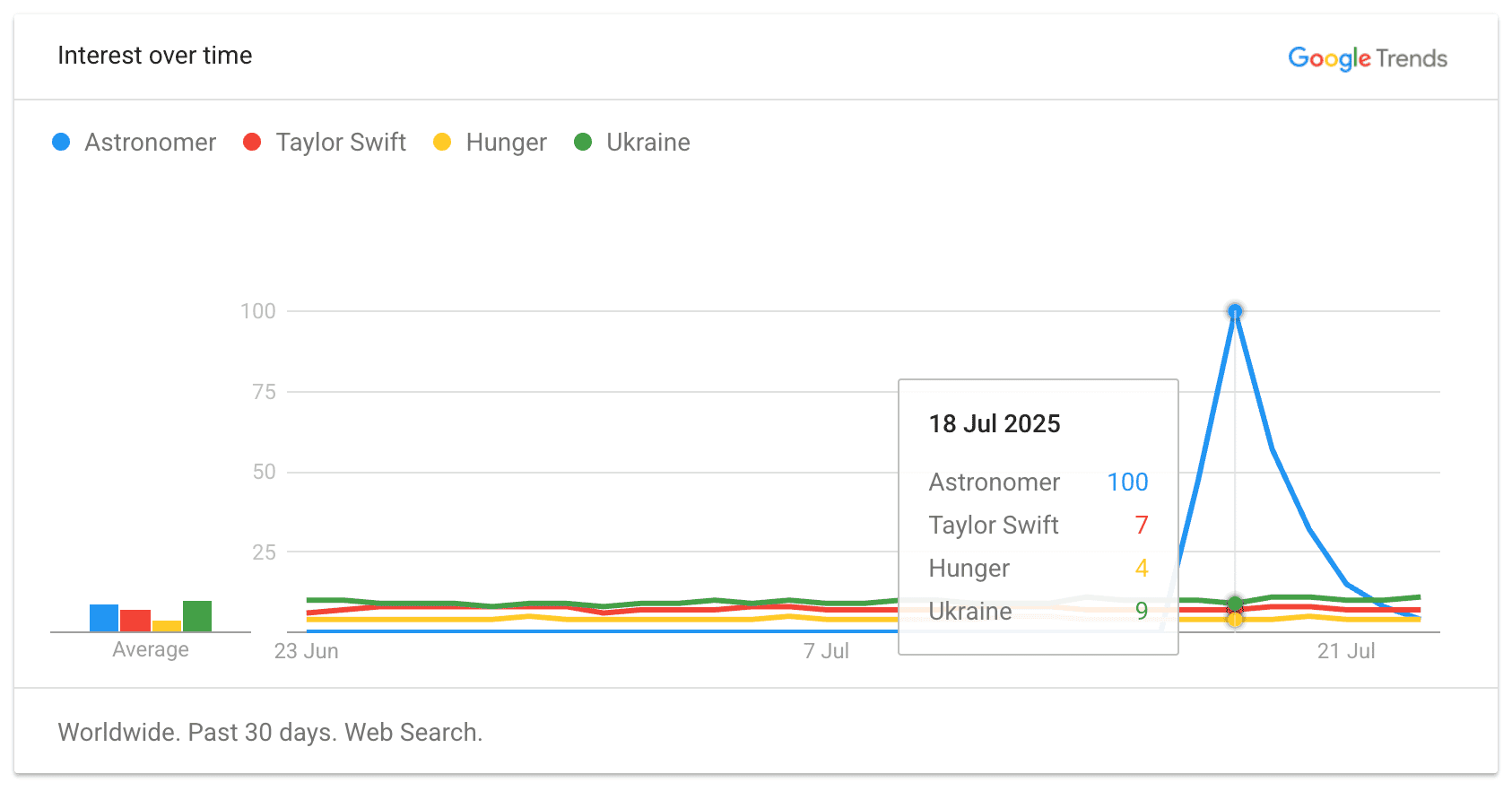
    Recently Astronomer ex-CEO Andy Byron was caught on camera having a mistress unknown to his wife. The internet went crazy about this, and we had thousands to maybe millions of people discussing how he was wrong to cheat of his wife etc.

    But really it doesn’t matter to anyone. Why do you care about a strangers relationship? Around the world millions of people get cheated on, and that hasn’t mattered in the slightest, then how come this became the talk of the country (even though everyone lost interest quickly after)?

    In this article we explore that, at least that’s what I wanted to do. Maybe I’ll do that once I get the time. Bye!