Category: Debate

  • We Built an AI Auto-Grader That Outperformed Humans. Here’s What It Means for the Future of College.

    We Built an AI Auto-Grader That Outperformed Humans. Here’s What It Means for the Future of College.

    As a Graduate Teaching Assistant at Arizona State University, my baseline job description was standard: teach labs, hold office hours, and grade. But if you put a team of software and AI engineers in a room with hundreds of repetitive worksheets, quizzes, and pre-labs, they’re going to do what they do best: build an automation engine.

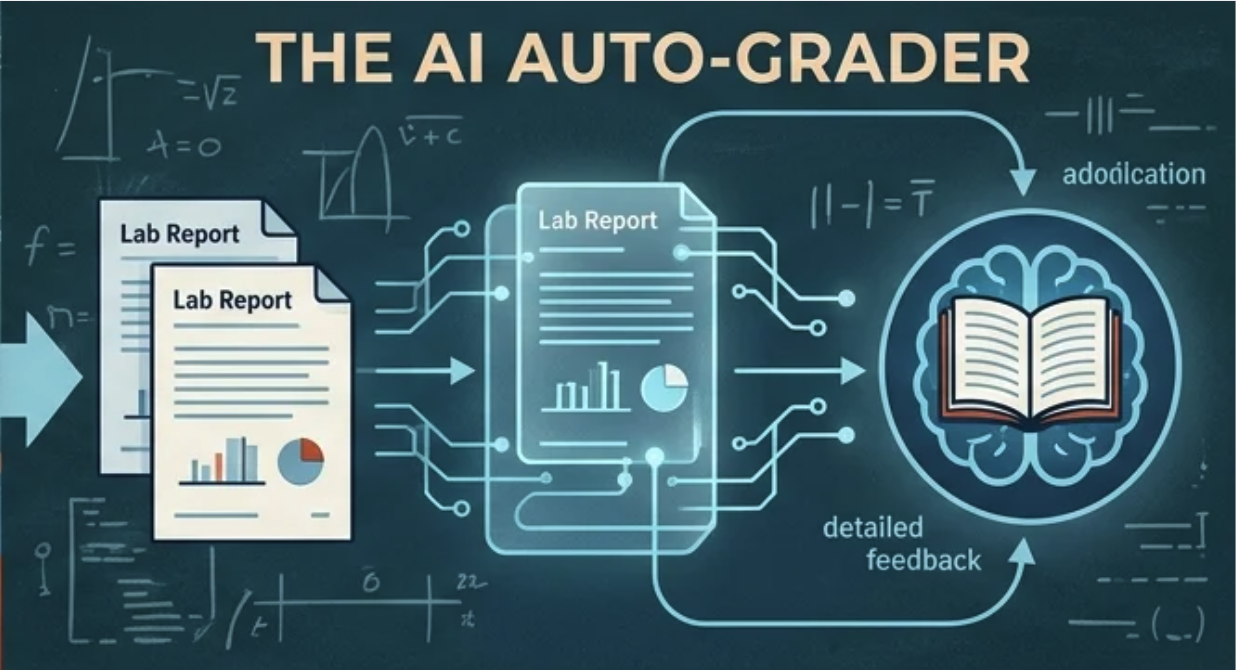
    My team and I set out to build an end-to-end AI Auto-Grader System integrated directly with Canvas. By the time we were done, we hadn’t just saved ourselves hours of manual labor—we discovered that the AI actually graded better and more objectively than human graders ever could.

    But getting there required bypassing massive data privacy hurdles, re-engineering data pipelines, and confronting a glaring question about the fundamental value of a modern university degree.

    The Architecture: Canvas, OpenRouter, and Excalidraw

    The core premise was straightforward: pull student submissions from the Canvas LMS API, grade them using LLMs, and push the scores back to Canvas alongside detailed feedback.

    To maximize accuracy, we didn’t just throw raw prompts at an API. We built a structured grading schema engine. The system ingested the master answer key, examples of partially correct answers, and explicit rubrics on how to allocate partial credit. We primarily relied on OpenAI LLMs for inference, with a fallback routing mechanism to OpenRouter to handle rate limits and test alternative open-source models.
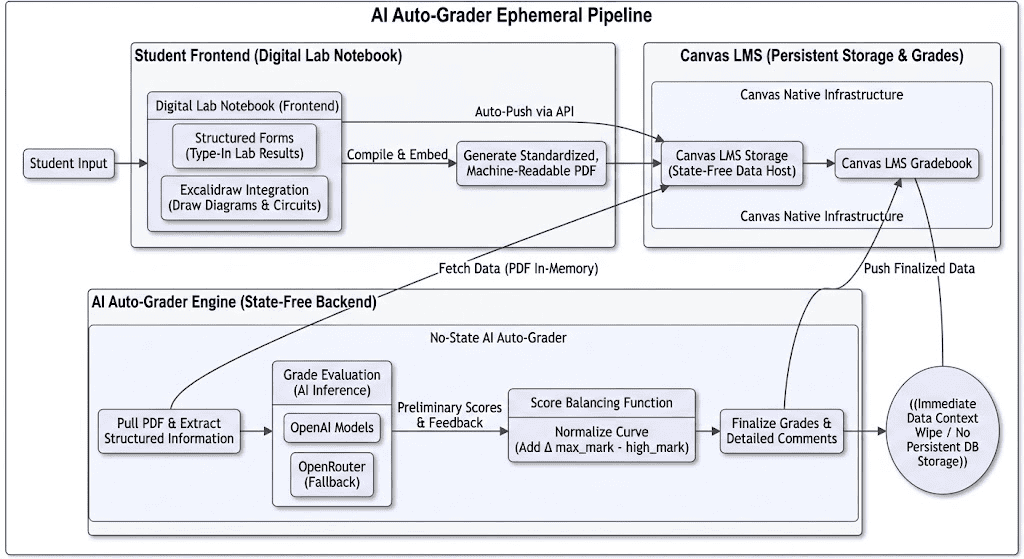
    To prevent the AI from being overly punitive, we also engineered a programmatic grading balancer. The function calculated the delta between the highest achieved mark and the maximum possible mark, automatically normalizing the curve across the cohort to ensure fair evaluation.

    Bypassing IT Hurdles Without Storing Data

    Our biggest bottleneck wasn’t the AI—it was compliance. The ASU IT software approval team enforces strict quality and privacy standards. The primary directive: The software absolutely could not store student information.

    Grading a student without holding state or keeping a database of their records forced us to build an ephemeral data pipeline. Initially, we had to resort to pulling raw PDFs from Canvas, running inference in memory, pushing the grades, and immediately wiping the data context.

    To bypass the brittle nature of OCR on random student PDFs, we built a custom frontend. Students entered their answers directly into structured fields, which supported digital drawings via an integrated Excalidraw canvas. When a student hit submit, this data was cleanly embedded into a standardized PDF format and auto-pushed to Canvas, giving the LLM a pristine, structured document to evaluate in real-time.

    The Discovery: Why AI Graded Better Than Us

    When we compared the AI’s performance against human grading, the results surprised our professors. The AI was objectively superior in three core areas:

    • Absolute Objectivity: Human graders are prone to fatigue, cognitive load, and accidental bias. An essay graded at 11:00 PM after a long day looks different than one graded at 9:00 AM. The AI evaluated the last paper with the exact same baseline logic as the first.
    • Hyper-Detailed Feedback: The bottleneck for human TAs is time. We can only write so many paragraphs of explanation per student. The AI, however, provided massive, highly nuanced, and descriptive feedback on why a mark was deducted and how to fix it.
    • An Actionable Feedback Loop: Because the comments were so detailed, students actually used them to improve on subsequent labs. It turned grading from a punitive metric into a genuine learning tool.

    The Existential Question: If the University is AI, Why Pay for the University?

    The success of this project was supported by ASU, and the faculty loved the efficiency. But as engineers building this reality, it forced us to look at the horizon.

    If an AI auto-grader can evaluate technical work more accurately and provide better mentorship via feedback than a human expert constrained by time, the role of the traditional educator changes fundamentally. Teachers and graders will either become prompt architects and supervisors, or find themselves increasingly obsolete in the administrative loop.

    This shifts the existential crisis down to the consumer—the student.

    If the primary value of higher education has historically been access to expert evaluation, structured feedback, and curriculum delivery, what happens when that entire stack can be run locally or via a cheap API? If a student can deploy an open-source agentic pipeline to guide them through a textbook, test them, grade them objectively, and explain their mistakes for pennies, why pay tens of thousands of dollars for a university degree?

    We built a tool to solve a logistics problem in a university lab. In doing so, we might have just caught a glimpse of how the traditional university model unbundles itself from the inside out.

  • Hackathons might be Dying

    Hackathons might be Dying

    I’ve attended few hackathons, often through ASU, and they’ve painted a disappointing picture of what hackathons are or have become.

    Online, especially in memes, hackathons are often portrayed as high-energy events full of incredibly skilled, competitive developers building impressive prototypes in record time. In reality, many of the ones I’ve attended were filled with students still very early in their learning journeys, several struggling with basic remote deployment or project setup.

    Most recently, I attended Sunhacks, one of ASU’s larger hackathons. While I appreciate the effort that went into organizing it, I left unsure of what the event was really trying to achieve.

    The strong presence of sponsoring companies, Google, Amazon, Base44, and others, seemed to steer the event toward lame AI-related projects. I don’t think this was intentional; it’s just what happens when the showcased tools and challenges revolve around LLM APIs. As a result, many teams, including mine, ended up producing AI-driven web apps that all felt somewhat similar. Very few projects stood out as novel or experimental, and even the more creative ones didn’t seem to receive much recognition.

    The judging process also suffered from scaling issues. There were too few judges for the number of teams, which likely led to uneven evaluations. Early teams had a better chance of being seen thoroughly, while others may have been skipped or reviewed hastily. This kind of fatigue bias is well known, and should be easy to plan around, but somehow, the organizers missed it completely.

    That said, there were positives. The event offered great opportunities to socialize and meet new people, and I got to see several neat ideas and clever implementations from other teams, even if none of them ended up winning.

    Still, it’s hard not to notice the broader trend. With the economy tightening and companies hiring fewer students, there’s a growing sense of disengagement at these events. Many company representatives seemed to be there merely to maintain a presence, devoid of any real enthusiasm.

    It maybe suggests a larger trend, a waning trust in the economy at large, where both companies and students are becoming more cautious, more restrained, and less optimistic about the near-term and possibly long-term as well.

    If you’ve had a different experience, I’d love to hear your thoughts.

  • Introversion isn’t real

    Introversion and Extroversion Might Not Be What You Think

    We’ve all heard of introverts, extroverts, and now, ambiverts — people who fall somewhere in between. But what if these labels don’t fully capture what’s really going on? What if your “vertedness” has less to do with your personality and more to do with what you’re talking about?

    Here’s the thing: many people who call themselves introverts seem to come alive when talking about topics they’re passionate about. I’ve had phone conversations with self-proclaimed introverts that lasted for hours — full of energy, laughter, and zero social exhaustion. Yet, these same people would be considered introverts in more general social settings. Why is that?

    It’s often said that introverts need alone time to recharge after social interaction, while extroverts gain energy from being around others. But I’m not convinced it’s that simple. Maybe introverts just need conversations that matter to them. Or maybe anyone would feel drained if the topic didn’t interest them.

    Think about it. An introvert might feel completely drained after small talk about the weather or sports they don’t follow, but light up when the topic turns to video games, anime, philosophy, or science. Suddenly, they’re animated, talkative, and far from shy or quiet. And guess what? They’re still not exhausted afterward.

    Now flip the scenario. Imagine an extroverted football fan dropped into a room full of people passionately discussing the latest anime series. That same extrovert might suddenly go quiet, unable to contribute or stay engaged. The social energy they usually thrive on isn’t there anymore. They’re the quiet one now.

    So what’s really going on here?

    It seems that our ability to connect, engage, and enjoy social interaction depends heavily on how much we relate to the topic being discussed. If the subject is meaningful or exciting to us, we’re energized, regardless of whether we think of ourselves as introverts or extroverts. If not, we’re likely to withdraw, get bored, or feel drained.

    This even plays out in real-world scenarios. Consider someone who moves to a new country. They were the life of the party back home, constantly social and upbeat. But now they barely speak the language, don’t understand the local culture, and have no connection to the popular sports or media. Suddenly, socializing feels like work. They’re tired after every conversation. Have they become an introvert? Or are they just out of sync with the topics and cues that used to make connection easy?

    Maybe the idea of introversion and extroversion is more flexible than we thought. Maybe your social energy depends not just on who you’re with, but on what you’re talking about and how much it aligns with what matters to you.

    If that’s true, then perhaps being an introvert or extrovert isn’t a fixed trait, but a reflection of how easily you can relate to the conversations around you.

  • People Love Numbers and Stats

    Having good tracking and feedback leads to great progress.

    I’ve noticed that people work really hard on tasks when it is very evident exactly how something can be changed or improved or if there is at least an illusion of such evidence.

    In school, children are measured on a number of parameters, test scores, athletic performance, debate competitions etc. Improving those metrics are associated with success, so kids attempt to improve those metrics and they very often are successful.

    People who trade shares on the stock market tend to increase their portfolio over time, adding money to the portfolio when they can. Few quite buying shares on the stock market, some invest passively, but most after starting to invest, keep investing. I am suggesting that this is also because there are numbers indicating the users success in the stock market and a somewhat evident path to success on the stock market.

    Let’s consider a more negative example, gambling, people who take up gambling often continue despite knowing full well that they are losing a lot of money in the long run. Here again, there are metrics showing you exactly how well you’re performing and what strategies you may try to improve your chances at winning.

    Another example in fitness, biking/running vs weight training, if you join a run club or biking club and go for a couple of events, you’re likely to continue going. Your gym membership on the other hand, is very easy to quit. Most users buy a gym membership at the start of a new year and quit before January is over. While there are those who quit running too, the likelihood is far greater for your weight training. Why is this? One answer is community and accountability, which is fine. But another reason is tracking and feedback. Fitness trackers are very good at recording your runs, your exact cadence, run power, heart rate, distance ran and various other metrics. This lets you keep track of your performance and helps you attempt to improve these numbers. If you did a very long run, but you didn’t know how far you’d managed to go, then it isn’t as interesting.

    So I think people can thrive with good statistics and clearly evident pathways to improve their life. But this is almost entirely missing in adult life. There is no manual or handbook to live life. Nothing telling you what next step to take to advance your life. Most of the growth in a person’s life happens during School and University. Then growth stagnates. If this is because there are no clear success indicators, couldn’t we put those back in?

  • CEO’s Affair turns into Great Marketing?

    CEO’s Affair turns into Great Marketing?

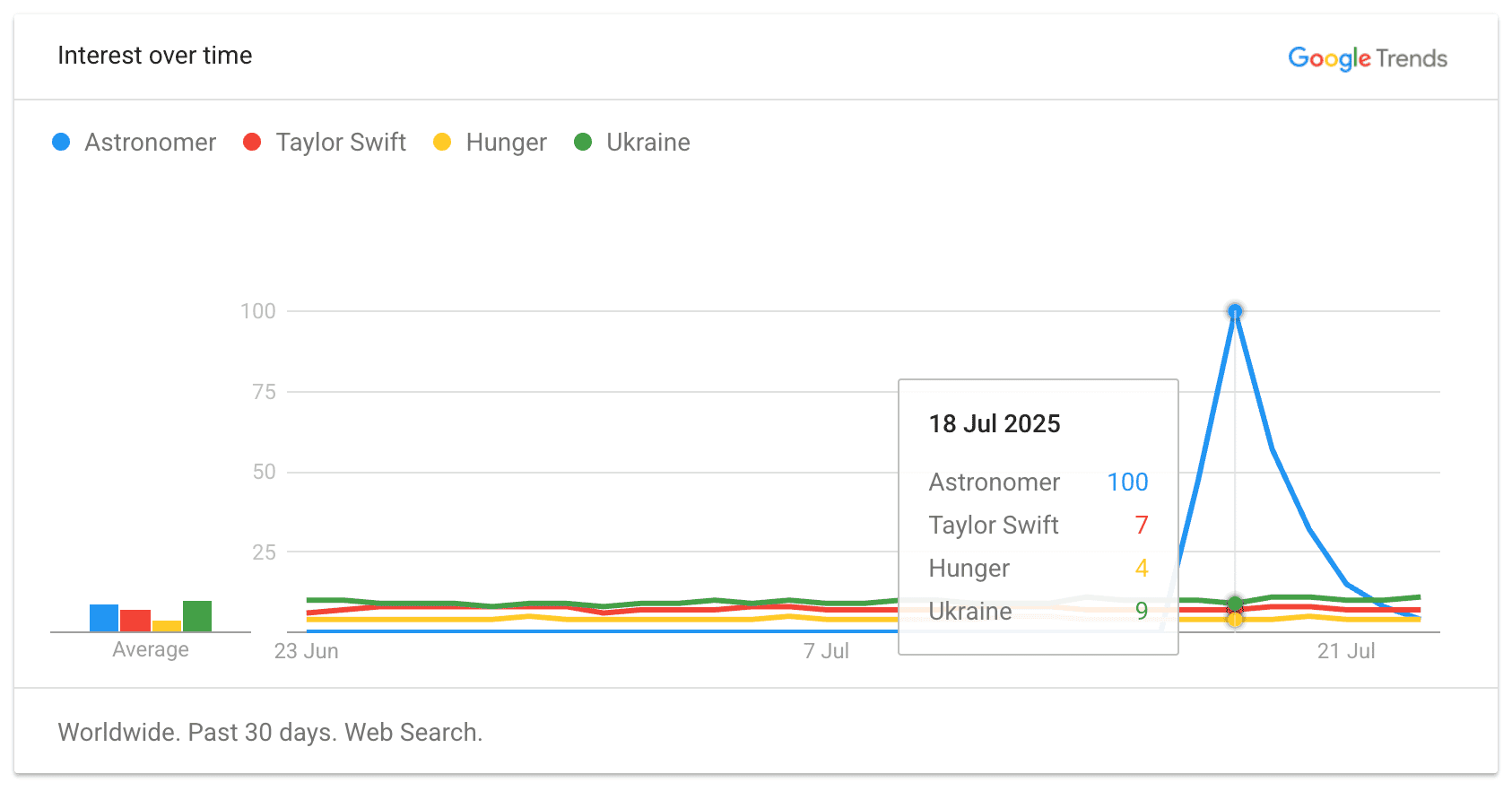
    Recently Astronomer ex-CEO Andy Byron was caught on camera having a mistress unknown to his wife. The internet went crazy about this, and we had thousands to maybe millions of people discussing how he was wrong to cheat of his wife etc.

    But really it doesn’t matter to anyone. Why do you care about a strangers relationship? Around the world millions of people get cheated on, and that hasn’t mattered in the slightest, then how come this became the talk of the country (even though everyone lost interest quickly after)?

    In this article we explore that, at least that’s what I wanted to do. Maybe I’ll do that once I get the time. Bye!